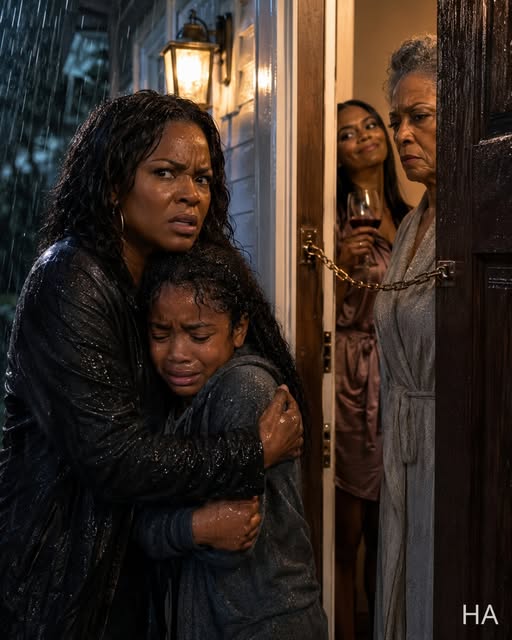
Brittany stared at you as if you had become someone unrecognizable.
Maybe you had.
Or maybe she was finally seeing the woman who had been there all along, hidden beneath fatigue and obligation.
You walked to the car and lifted Hannah carefully. She stirred, murmuring into your shoulder.
“Mom?”
“We’re home.”
Her eyes opened halfway.
“Grandma?”
“She won’t hurt us tonight.”
That was not the same as saying everything was fine.
You would not lie that far.
When you carried Hannah through the front door, Lorraine reached toward her.
“Hannah, sweetheart—”
Hannah flinched so hard her blanket slipped.
The room went silent.
Your mother’s hand froze in the air.
For a second, something like pain crossed her face.
Good.
Let her feel one percent of what she had put in your child.
You carried Hannah upstairs to her room.
The door was open.
Her bed had been stripped.
Brittany’s boxes covered the floor.
A framed ultrasound picture sat on Hannah’s dresser.
Your daughter saw it.
Her face crumpled.
“Is Aunt Brittany taking my room?”
You pressed your lips to her forehead.
“No.”
You placed Hannah on the bed and covered her with blankets from your linen closet. Then you picked up the ultrasound frame, walked downstairs, and placed it in Brittany’s open suitcase.
“Your things are in my daughter’s room,” you said.
Brittany’s husband, Kyle, had appeared by then. He wore a Tampa Bay T-shirt and the sleepy confusion of a man who had not expected police to be part of his relocation plan.
“Elena,” he said, “can we just talk about this?”
“You stood by while my daughter was locked out?”
He rubbed his face.
“I didn’t know she was outside that long.”
“How long would have been acceptable?”
He looked down.
At least he had enough shame not to answer.
Your mother moved toward the stairs.
“I’m going to speak to Hannah.”
You stepped in front of her.
“No.”
“I am her grandmother.”
“You were her grandmother when you left her in the rain.”
Lorraine’s face hardened.
“I did not know it would storm.”
You stared at her.
“It’s Florida in July.”
Deputy Ramirez looked like he wanted to say something and was professionally holding it back.
Brittany and Kyle left at 3:18 a.m.
Not gracefully.
Not quietly.
But they left.
Two deputies supervised while they packed the boxes already stacked in the hall and loaded them into Kyle’s pickup and Brittany’s SUV.
Brittany cried loudly on the porch about being pregnant and homeless.
You watched from the doorway.
No one in that house had called Hannah homeless when she was outside in the rain.
Your mother did not leave that night.
The law made that part slower.
But she slept in the downstairs guest room, not the primary bedroom, after David made it clear that any further interference with your access would be used in court.
You changed the locks again before dawn.
This time, with a locksmith Deputy Ramirez recommended.
This time, you held the keys.
One for you.
One for Hannah.
No one else.
At 5:04 a.m., you sat on the edge of Hannah’s bed and watched her sleep.
Her cheeks had color again.
The soaked rabbit lay beside her, now wrapped in a towel.
Your scrubs were wrinkled, your hair smelled like rain, and your phone had twenty-three missed calls from your supervisor, Brittany, and a cousin who suddenly cared about “family peace.”
You did not answer any of them.
David stood in the doorway.
“You should sleep.”
You laughed softly.
“I’m an ER nurse.”
“That is not a personality.”
“It is now.”
He smiled sadly.
“Your father would be proud.”
You looked at Hannah.
“He should have told me sooner.”
“Yes,” David said.
The honesty surprised you.
You turned.
He did not soften it.
“Thomas loved you deeply. He also avoided conflict with Lorraine until it was too late. Both things are true.”
Your eyes burned.
“I’m so angry at him.”
“You’re allowed.”
That permission opened something in you.
You had spent years turning anger into usefulness. Medication schedules. Grocery lists. Hospice calls. Work shifts. Tuition forms. Hannah’s homework.
Anger had no place to go, so it became service.
Now it sat in your chest, demanding a room.
“He let her call me ungrateful while I was cleaning his catheter,” you whispered.
David’s face tightened.
“I know.”
“He let Brittany visit for twenty minutes and leave with his credit card for ‘errands.’”
“I know.”
“He let Mom tell everyone she was his caregiver.”
David nodded slowly.
“He was weak with them.”
You closed your eyes.
“He was not weak when he was sick.”
“No,” David said. “But a person can be brave in pain and cowardly in family.”
You cried then.
Quietly.
Because Hannah was asleep.
Because the house was yours.
Because your father had saved you too late and still saved you.
The next morning, Lorraine began her campaign.
By 8 a.m., relatives were calling.
By 9, Brittany posted on Facebook:
Imagine being pregnant and getting thrown out by your own sister after your father dies. Some people show their true colors when money is involved.
By 9:12, your Aunt Carol commented:
Your father would be ashamed.
You took one screenshot.
Then another.
Then sent them to David.
He replied:
Excellent. Keep documenting.
You did.
Screenshots.
Texts.
Voicemails.
Photos of your belongings in wet garbage bags.
Hospital discharge notes for Hannah.
Locksmith receipts.
Deputy report number.
Your father’s letter.
The trust documents.
The occupancy clause.
The more they lied, the more evidence they gave you.
Lorraine tried sweetness next.
She made coffee and brought it to the kitchen where you sat with Hannah wrapped in a blanket.
“Honey,” she said softly, “last night got out of hand.”
Hannah looked down at her cereal.
You looked at your mother.
“Do not talk to her.”
Lorraine flinched.
“Elena, don’t be cruel.”
You almost laughed.
Cruel.
That word was always available to mothers who mistook consequences for disrespect.
“You changed the locks.”
“I was overwhelmed.”
“You left Hannah outside.”
“I thought she had gone to a friend’s.”
“She called you twelve times.”
Lorraine’s eyes flicked to Hannah.
Your daughter whispered, “You declined my calls.”
Silence.
Your mother had no answer.
Hannah’s voice trembled, but she kept going.
“I saw it. It rang once and stopped. Then Aunt Brittany texted me to stop being dramatic.”
Your hand tightened around your coffee mug.
Lorraine’s face went pale.
You had not known that part.
“Show me,” you said gently.
Hannah retrieved her phone.
There it was.
Stop being dramatic. Your mom knows. Sit in the garage if you’re scared.
The timestamp was 5:36 p.m.
The storm warning had been issued at 4:50.
Your mother saw the text.
For one second, even she looked shocked.
Then she did what she always did.
She protected Brittany.
“Your sister is under stress.”
You stood.
“So am I.”
“Elena—”
“No. You will not use Brittany’s pregnancy to excuse cruelty to my child. Not in my house.”
My house.
The words tasted strange.
Strong.
Terrifying.
Lorraine heard them too.
Her eyes hardened.
“This house made you arrogant overnight.”
“No,” you said. “This house showed me what you were willing to do when you thought I had no power.”
She slapped you.
Not hard enough to knock you down.
Hard enough for Hannah to scream.
The room went still.
Your cheek burned.
Lorraine’s hand hung in the air.
Her face changed immediately.
Not remorse.
Calculation.
“Elena—”
You picked up your phone and dialed Deputy Ramirez’s card.
Your mother stared.
“You wouldn’t.”
You looked at her.
“You just hit the homeowner in front of a child after locking that child outside in a storm.”
Her mouth opened.
“You wouldn’t call police on your own mother.”
You held her gaze.
“Watch me.”
By noon, Lorraine was removed from the property under an emergency protective order.
Not arrested that day, though Deputy Ramirez made it clear charges could follow depending on the investigation. But she was ordered to leave. No contact with Hannah. No unsupervised return. No harassment.
She stood on the porch with one suitcase, looking smaller than you had ever seen her.
Brittany arrived screaming before the deputy finished explaining the order.
“You’re destroying this family!”
You looked at her.
“No. I’m refusing to be its trash bag.”
She stared.
“What?”
“For years, everything you didn’t want to carry got handed to me. Dad’s care. Mom’s bills. Your emergencies. Your guilt. Your lies. I carried all of it because I thought being family meant being useful.”
You stepped closer.
“Then you put my child in the rain.”
Brittany looked away first.
“You don’t understand what I’m going through.”
“You’re right,” you said. “And after last night, I no longer need to.”
Your mother left with Brittany.
No apology.
No goodbye to Hannah.
Only one final look at the house, as if the walls had betrayed her.
The weeks that followed were brutal.
Not because you missed your mother.
Because peace after chaos feels suspicious at first.
Hannah jumped whenever a car slowed outside.
You checked the locks three times every night.
You returned to work and found your supervisor had written you up for abandoning your shift. Dana threatened to quit on your behalf. The hospital eventually withdrew the discipline after you submitted the police report and pediatric ER documentation.
Brittany’s Facebook campaign lasted six days before David sent a cease-and-desist letter.
Then the posts vanished.
The relatives went quiet.
Funny how quickly family stops demanding peace when defamation becomes expensive.
You began restoring the house.
Not redecorating.
Restoring.
You moved Hannah back into her room and let her choose new curtains. She picked yellow, because she said the room needed to feel like morning.
You donated Brittany’s abandoned crib to a women’s shelter.
You moved your father’s recliner back near the window, not as a shrine, but because the room looked wrong without a place for memory.
You cleaned the garage.
That was hardest.
You found your clothes mildewed in trash bags.
Your nursing textbooks warped from rain.
Hannah’s art projects ruined.
The blue sweater your father had worn during his last Christmas was damp but salvageable.
You washed it by hand and cried into the sink.
One afternoon, while sorting boxes, you found a small metal tin tucked inside your father’s old fishing cooler.
Inside were photographs.
You as a child, missing front teeth.
You in nursing school.
Hannah as a baby asleep on your father’s chest.
And beneath them, another letter.
Not legal.
Personal.
Elena,
If David did his job, you now know about the house. But I need to say what the deed cannot. I failed you by allowing your mother and Brittany to take your loyalty for granted. I told myself you were strong, and I let that become an excuse to ask more of you.
You were never the spare daughter. You were the steady one. I confused steady with endless.
I am sorry.
If you can, make this house lighter than it was. Let Hannah laugh loudly. Paint walls. Play music. Lock doors when you need to. Open them only to people who come with love, not entitlement.
Dad.
You sat on the garage floor and cried until Hannah found you.
She did not panic.
She sat beside you and leaned her head against your shoulder.
“Is it Grandpa?”
You nodded.
She picked up the photo of herself asleep on his chest.
“He loved us.”
“Yes,” you whispered.
“Grandma did something bad.”
“Yes.”
“Both can be true?”
You looked at your daughter.
Eleven years old.
Too wise because adults had failed to be kind.
“Yes,” you said. “Both can be true.”
So you made the house lighter.
You painted the kitchen pale blue.
You replaced the heavy curtains Lorraine loved with linen ones that let sunlight in.
You let Hannah put glow-in-the-dark stars on her ceiling.
You played music while making breakfast.
You bought a new porch swing.
On the first dry Saturday after the storm, you and Hannah planted marigolds by the walkway.
Hannah placed her soaked rabbit, now cleaned and patched, in the porch chair to supervise.
“This house feels different,” she said.
“Good different?”