Her beautiful, soft “yes, Daddy” face peeled away like old paint. Underneath was something that made his stomach turn.
She wrinkled her nose. She made a sound in her throat that was halfway between a laugh and a hiss.
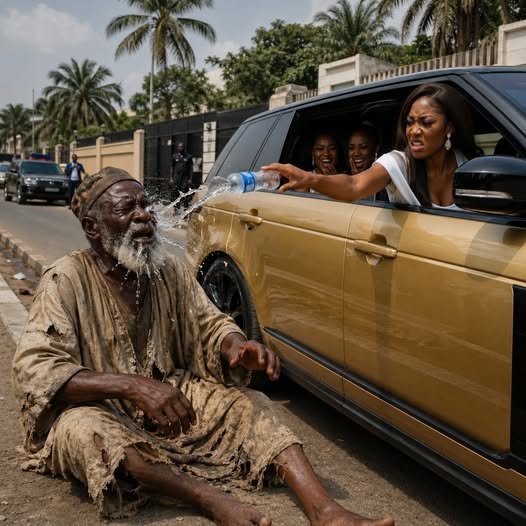
“Get away from my car, you smelly thing, before you stain my paint.”
Then she picked up a half-empty bottle of water from her cup holder and threw it at his face.
It hit his cheek. Water ran down his neck and into the gutter.
Her cousins burst out laughing.
One of them said, “Vanessa, you are too much.”
And Vanessa laughed too.
It was the kind of laugh a person laughs when they have hurt someone weaker than them and believe no one important is watching.
The window rolled up. The gold Range Rover drove through the gate.
Chief Bernard sat there for a full minute. He did not move. Water dripped from his beard onto the torn agbada.
He thought about his son sleeping in a hotel in Dubai, dreaming of his wedding day. He thought about the boy Daniel had been at six years old, holding his father’s hand at his mother’s funeral, asking why Mommy was not coming back.
He thought about how much love he had poured into raising that boy, and how close that boy had come to giving his entire life to a woman who threw water at old men.
Then he reached into his agbada, pulled out his small phone, and called his lawyer, Barrister Okafor, the only person in Lagos who had his private number.
“Cancel the wedding. I have seen.”
But Chief Bernard was not finished.
He was not the kind of man who ended a hunt halfway.
He stood up slowly, his old bones aching from sitting on the cement, and began to walk.
He walked through the estate gates. He walked past the security men, who almost stopped him until he gave them a look they would later describe to their colleagues as the look of a chief from another world.
He walked past the fountains and manicured lawns. He walked all the way to his own mansion, where Vanessa’s gold Range Rover was already parked in the driveway.
The front door was open. The wedding planner had let her in.
Chief Bernard stood in the doorway in his torn agbada, his face still streaked with cooking soot, water still dripping from his beard, and he listened.
“And then this disgusting old beggar tried to come close to my window,” Vanessa was saying in the living room, laughing. “I almost vomited. Honestly, the way Daddy lets these people sit outside his estate is embarrassing. When I become Mrs. Okoye, the first thing I am going to do is clear those gates. No more beggars. No more useless old men. The estate must look international.”
Her cousins laughed.
The wedding planner laughed nervously, the way people laugh when they want to keep their job.
Then one of the cousins said something that made Chief Bernard’s hand close into a fist against the doorframe.
“And what about Daddy himself? You know he is old. He will die soon. What is your plan?”
Vanessa took a long sip of her drink.
The room went quiet.
She set the glass down on the marble table very gently.
“Daniel does not know how to manage money,” she said. “He is too soft. Too kind. When the old man dies, the company will need someone strong, someone who can make hard decisions. I will take care of Daniel. I will make sure he is comfortable. But the business is mine. Trust me, I have been planning this for two years.”
The wedding planner dropped her pen.
Vanessa laughed at the look on her face.
“Oh, please do not look at me like that. Every smart woman knows what she is marrying into. The difference between me and the others is that I am honest with myself.”
Chief Bernard stepped into the living room.
The laughter died as if someone had switched off a generator.
Vanessa turned, saw the dirty old beggar standing in her future father-in-law’s living room, and her face twisted in disgust.
“How did this thing get in here? Security! Security!”
She picked up another water bottle from her handbag and threw it at him. It missed and hit a vase on the side table. The vase fell and shattered on the marble floor.
Chief Bernard did not flinch. He did not move.
He just looked at her with his old, tired, terrible eyes.
Then he slowly reached up and pulled the cap from his head. He used a corner of the torn agbada to wipe the soot from his cheeks. He stood straighter, the way a chief stands.
And as Vanessa watched, the dirty old beggar in her living room transformed before her eyes into the man whose face she had seen on the cover of Forbes Africa.
Her glass slipped from her hand. It hit the marble floor and exploded into a hundred pieces.
“Daddy,” she whispered.
“Sit down, Vanessa,” Chief Bernard said.
His voice was very soft, very calm, the kind of voice that has buried armies.
“Sit down. We need to talk.”
She did not sit. She could not. Her legs had stopped working.
Her two cousins were already backing toward the door, their faces pale, their phones nearly falling from their hands.
The wedding planner had pulled a recorder from her bag, and the small red light was still blinking.
“Everything you just said,” Chief Bernard continued, “I heard every single word. And before that, at the gate, the old beggar you threw water on. The smelly thing. The disgusting old man you wanted cleared away when you became Mrs. Okoye.”
Vanessa’s mouth opened. Nothing came out.
“My son,” Chief Bernard said, and for the first time his voice cracked just a little. “My only son loves you. Do you know what love is, Vanessa? Real love? It is what made me sit on that cement block in the sun for two hours in clothes that smelled of suffering because I could not bear the thought of my child marrying a viper. I prayed I was wrong about you. I prayed every minute. And then you opened your window.”
He turned to the wedding planner.
“Madam, you have been recording?”
The wedding planner nodded, shaking.
“Yes, sir. I always record consultations for my own records. I am sorry, sir. I did not know.”
“Do not apologize. You have just saved my son’s life. Send me that recording, and I will pay you ten million naira tonight.”
The wedding planner began to cry.
Vanessa began to cry.
Her cousins were already running for the door.
Chief Bernard turned back to Vanessa. He looked at her for a long moment, then very quietly, almost gently, he said the line Lagos high society would whisper about for the next ten years.
“You wanted to be Mrs. Okoye. Today, you have become Miss Nobody. Now leave my house.”
Vanessa stumbled out.
She left her handbag. She left her car keys. She ran in her white dress through the marble hallway, past the fountain, past the security men, and out of the gate, where she stood in the Lagos sun with no money, no phone, no ride, and the slowly dawning understanding that her life—the life she had planned for two whole years—was over.
Chief Bernard sat down heavily on his sofa.
He poured himself a glass of water with hands that were finally allowed to shake.
Then he picked up his phone to call his son, who was about to lose a fiancée, but by the grace of God would not lose his life.
When Daniel landed at the Lagos airport the next afternoon, his father met him at the private terminal in person, something he had not done in fifteen years.
Chief Bernard was in his usual white agbada, his Rolex back on his wrist, his diamond ring back on his finger.
He held his son very tightly.
“Daniel,” he said into his son’s shoulder, “I have something to show you.”
He played the recording in the back of the car all the way from the airport to Banana Island.
Daniel listened in silence.
When it finished, he listened again. Then a third time.
He did not cry. He did not shout. He just stared out the window at the Lagos traffic, at the buses, the hawkers, and the children selling sachet water.