After a long, long time, he turned to his father and asked one question.
“The beggar at the gate. The smelly thing. That was you?”
“Yes, my son.”
“You sat there in the sun for two hours?”
“Yes.”
Daniel was quiet again for a long time.
Then he reached over and took his father’s old, wrinkled hand in his own, the way he had held it at his mother’s funeral when he was six years old.
“Thank you, Daddy.”
Chief Bernard cried then. Quietly. The kind of tears a man cries when he has carried a heavy thing alone for a long time and finally puts it down.
The wedding was canceled that same week.
Vanessa’s family tried everything. They sent emissaries. They sent priests. They sent her aunt, who had once been a senator’s mistress, to beg on her behalf.
Chief Bernard refused to see any of them.
The recording leaked, the way these things always leak in Lagos.
By the end of the month, no decent family in Nigeria would accept Vanessa as a wife. Her own father refused to take her calls. She moved to Abuja, then to Ghana, then to nowhere anyone could find her.
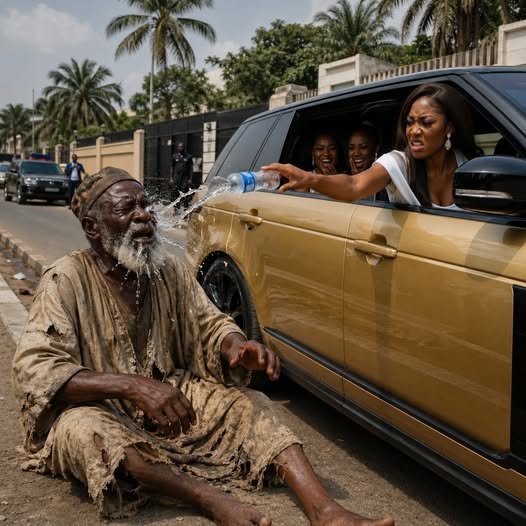
But Chief Bernard had not forgotten the woman in the Lexus.
It took his security team two weeks to find her.
Her name was Mrs. Adunni Bekare. She was a forty-six-year-old widow with three children. She worked as a secondary school teacher in Surulere. She drove the Lexus because it was her late husband’s car, the only thing of his she had refused to sell when the medical bills came.
The five hundred naira she had given the beggar at the gate had been her transport money for the next day.
Chief Bernard invited her to his house for tea.
She came in fear, thinking she had done something wrong.
He met her in the same living room where Vanessa had laughed about him dying. He poured her tea himself and told her very simply what she had done for him without knowing it.
He paid off her mortgage.
He set up a trust fund for her three children’s university education, in Nigeria or abroad, wherever they wanted to go.
He hired her on the spot to manage the new charity foundation he was starting in his late wife’s name. The foundation would feed beggars and homeless people across Lagos.
He named her executive director.
He paid her five times her teaching salary.
Mrs. Adunni Bekare cried into her teacup.
“But sir,” she kept saying, “I only gave you five hundred naira.”
“My daughter,” Chief Bernard told her, “you gave me five hundred naira when you thought I was nothing. Vanessa threw water at me because she thought I was nothing. That is the difference between a person and a soul. And I am old. I have very little time left to reward souls.”
Two years later, Daniel married a quiet primary school teacher named Chiamaka, who had once helped him fix a flat tire on the road to Enugu without knowing who he was. She had refused to take money from him. She had simply wished him safe travels and gone back to her class of seven-year-olds.
Chief Bernard cried at the wedding, the second time he had cried in two years.
And every Sunday afternoon, an old man in a torn agbada and a faded cap could sometimes be seen sitting on a cement block outside his own estate in Banana Island, watching the cars come and go, saying nothing, just watching the faces of the people who passed.
Some of them stopped.
Some of them walked past.
Chief Bernard remembered them all.
Because the way a person treats someone they think can do nothing for them is the truest face that person will ever show.
So today’s story is about a guy who watched his parents forget his daughter’s fifth birthday. Just straight up showed up with nothing. No card, no gift, no apology, just a pat on the head and a “we’ll make it up to her.” And look, that’s already bad.
But here’s where it gets wild. One week later, his niece is holding a brand new iPhone 17 Pro, courtesy of grandma and grandpa. Meanwhile, his 5-year-old got a shrug.
So, when his parents came asking about the 10,000 he’d promised for their kitchen, he forgot, too. 32 missed calls later, this thing went nuclear. And honestly, I’m on his side the entire time. My parents forgot my daughter’s birthday, but bought my niece an iPhone 17 Pro.
So, I forgot their $10,000 kitchen renovation. My parents forgot my daughter’s birthday. She was five years old, and it was her first big-kid birthday, as she called it, and they showed up empty-handed with a shrug and an “Oh, we’ll make it up to her.” I believed them.
That was my first mistake. My name’s Nate.
I’m 31, married to my wife, Jess for 7 years, and we live in a three-bedroom house in Raleigh, North Carolina. We’re not rich, but we’re not scraping by either. I’m a project coordinator at an architectural firm.
Jess is an operations manager at a midsize company downtown. Together, we do all right.
We drive used cars that are paid off. We’ve got a decent backyard.
And we meal prep on Sundays like boring, responsible adults. We have one daughter, Lily.
She just turned five, and she’s the kind of kid who talks to butterflies and saves her Halloween candy for months because she doesn’t want the chocolate to feel left out. Last week, she put a band-aid on a stuffed animal because it looked sad. Yeah, she’s that kind of sweet.
So, picture this. It’s Lily’s birthday party.
We’ve got streamers, a unicorn cake, the whole setup. My parents, Frank and Linda, show up 40 minutes late, which honestly is early for them. My mom walks in, gives Lily a squeeze, and says, “Happy birthday, sweetheart.” My dad pats her head like she’s a golden retriever.
No gift bag, no card, nothing. Did I say something right then?
Of course not. I bit my tongue so hard I could taste metal because that’s what sons like me do. We keep the peace.
We smile. We tell ourselves it’s fine.
My sister Claire was there with her two kids, 13-year-old Zoe and 8-year-old Caleb. Claire’s two years older than me, divorced, and honestly, one of the best people I know. She’d brought Lily this huge art set with, like, 60 colors and a little easel.
Lily nearly passed out from excitement. Claire looked at me sideways when our parents came in with nothing, and I just shook my head. Not now.
After the party, when everyone went home and Lily was in bed, surrounded by wrapping paper like some kind of gift tornado, Jess sat down next to me and said,
“So, your parents really didn’t bring anything?”
I told her they forgot.
She just looked at me.
“You know that look your wife gives you when she’s trying not to say what she’s really thinking?”
“Yeah, that one.”
She took a breath, nodded, and said,
“Okay.”
I could hear everything she wasn’t saying. Here’s the thing, and I know some of you are probably already figuring this out. My parents have always been uneven.
Not bad people, not monsters, just uneven. Claire’s kids, my mom has them over every other weekend. She takes Zoe shopping.
She bakes with Caleb. She posts photos of them on Facebook with captions like, “Grandma’s angels.” She made Caleb a custom Halloween costume last year. She went to every single one of Zoe’s school concerts.
Lily. She’s been to their house maybe six times in her entire life. My mom has missed two of her birthdays now, and I only just realized I’d been keeping count without meaning to.
I used to tell myself it was geography. We live 20 minutes away.
Claire lives 5 minutes away. But 20 minutes isn’t far.
That’s a podcast episode. That’s the drive to get groceries.
And then I’d see the photo albums. My mom kept pages and pages of Zoe and Caleb—field trips, holidays, random Tuesday afternoons—and one blurry picture of Lily from her christening wedged in the back like an afterthought. You ever notice something that breaks your heart, but you convince yourself you’re overreacting?
Yeah, that’s been my whole life. Anyway, one week goes by.
No makeup gift for Lily. No call, no card, no little something in the mail. I don’t say anything because I’m still giving them the benefit of the doubt.
That’s what good sons do, right? Then day eight happens.
I’m scrolling through Facebook because apparently I enjoy emotional damage. And there’s a photo from my mom’s page. Zoe sitting at my parents’ kitchen table holding a brand new iPhone 17 Pro.
The caption read, “Only the best for our girl. Grandma and Grandpa’s little smarty pants.” I stared at that photo for I don’t know how long—long enough that the screen dimmed twice and I had to tap it back to life. I zoomed in on the phone box in the background.